If you’re a social buttery fly that loves to go out for a couple of glasses
of wine, or a chocolate monster that craves sugar when you’re bored,
or you’re just a plain old dieter who starts diets one week and
crashes and binges the next, you are going love what you’re about to
discover.
First up, I’d like to re-assure you that everything you may have
read or been told about habit formation is either wrong or
has mislead you into more a confused and destructive behaviour
which you may have been unable to get yourself out of.
You’ve probably heard people saying it takes 21 days to form
a new habit? Well that’s a load of BS in my eyes, because
you are an individual with your own characteristics,
lifestyle influences and habits, so it will take however long
it takes YOU, until it become second nature.
You see, to change habits you need to understand simple Brain science.
Now picture yourself brushing your teeth in the morning, tying
your shoes laces before you go for a mini workout or switching
on the light when you enter a room, or reversing out of a
drive way.
You do all of these things without thinking about it because
you know what to do. It has become second nature.
Now imagine yourself performing an activity which you don’t
like… it would feel a little alien to you at first, right?
Well that my friend creates a new path in the brain which gets
stronger the more you perform the same task.
If you are a person with any sort dependency issue, like
giving up chocolate, wine or smoking, then it’s essential that
you grasp the basics of brain function for 2 reasons;
1) It will make it clear to you exactly why your struggling
to give up a habit that is very clearly making you very
unhappy.
2) It will help you realise that your dependency is not a
fault on your part, nor an act of self-sabotage, or that you are
a willpower wuss.
Instead it will give you a deeper understanding of the mechanisms
at play and thus empower you to make positive changes.
BRAIN ANATOMY & WHAT EACH PART DOES
Most of the problems and struggles that you are facing when it
comes to your diet will be conjuring at BRAIN level.
It’s important to note that the brain controls the mind and
NOT vice versa.
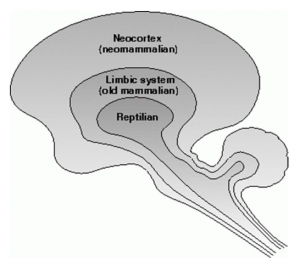
Below is a picture which you can use to understand brain
function at a basic level, and how it applies to you.
THE REPTILIAN BRAIN
The human brain originated as a much smaller entity than what
we have today. In the beginning, we had a reptilian brain which
served a few very basic functions.
The reptilian brain is the most primal part of our brain and
is responsible for keeping us alive. It drives our survival
instinct and is dedicated to keeping us safe and protected.
It’s also responsible for the behaviours of aggression, dominance
and mating.
So, when you think of the reptilian brain, you can think of it
as being responsible for the 5 Fs of survival both as an individual
and a species:
1) Fight 2) Flight 3) Freeze 4) Food 5) F***
(Because of course, reproduction is key to our survival!).
THE LIMBIC SYSTEM
As mammals evolved we developed a second ‘layer’ to our
brains, the Mammalian brain (also known as the LIMBIC SYSTEM).
?
This part of the brain moved mammals beyond primal survival
functioning and allowed them to experience motivation, emotion,
and display goal behaviours. Indeed, the limbic system is the
goal-driven part of the modern day brain.
The youngest part of the brain is the Neocortex, or
Neomammilian/human brain. This is what enabled the human species
to really set itself apart from other mammals.
The Neocortex gives us the capacity for language, abstraction,
reasoning, logic and meaning. Within the 3 layers of the brain,
there are a number of key structures it’s important for you to
be aware of before we continue our journey into truly effective
nutritional breakthrough coaching.
Below is a diagram of the lobes of the brain:
THE KEY STUFF YOU NEED TO KNOW ABOUT THE BRAIN AS AS FOLLOWS
The Brain Stem
At the base of the brain you’ll see the brain stem. This is part
of the original reptilian brain and is its oldest part. It is
also THE BOSS. The brain stem is responsible for our reactions
to things (behaviours that involve no cognitive thought). This
is the part that kicks straight into gear when any sort of
threat is presented (or just perceived). If the brainstem
perceives there to be a threat, none of the rest of the brain
gets a look in because the brain’s primary concern is survival.
This makes sense because often, in times of threat, there isn’t
time to stand about deliberating over the best action to take.
It just happens automatically.
The Cerebellum
This part of the brain receives sensory date from both internal
and external stimuli, and is the place where sensory maps are
put together. On accumulating this data the cerebellum also
asks, ‘AM I SAFE?’ The cerebellum receives its visual from The
Occipital Lobe.
The Parietal Lobe
The parietal lobe is where motory sensory data is accumulated
and computed into movement maps. It is also responsible for
spatial sense and navigation. Damage here therefore often leads
to loss of movement or dysfunction.
The Frontal Lobe
The frontal lobe, a resident of the neocortex, is where all
our cognitive processing takes place such as your thinking
processes, reasoning and the attribution of meaning. This is
where the things that we really desire in life sit, such
as our goals.
It’s important at this point to note the difference between
desire and require. When your brain requires something it is
pretty convinced it absolutely has to have it in order to
survive. This is a reptilian response in which we will go
into more detail shortly. When the brain desires something,
however it doesn’t consider it a life or death need.
One of your main aims is to turn desires into requires so
that the optimal behaviour you seek becomes your GO TO
automatic behaviour. This transition cannot happen, however,
in the presence of threat.
So that’s a brief overview of brain anatomy as it relates to
habit formation. Now let’s take a look at how it actually
works….
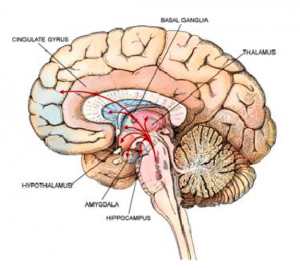
COMPONENTS OF THE LIMBIC SYSTEM
When it comes to emotional and disordered eating, there’s some
significant structures to familiarise yourself with. Check out
the diagram below:
The Thalamus
The thalamus is a smallish structure in the centre of the brain
located in the limbic system, close to the reptilian brain.
This little guy is in charge of integrating sensory information,
as well as motor coordination. It’s also the little rascal
that’s responsible for your alertness and sleep levels – ie.
If the brain perceives there to be a threat present, it will
make darn sure you don’t sleep a wink (because obviously you’re
not going to be able to protect yourself if you’re catching
40 winks). What happens when the thalamus perceives a threat
is that it relays this message to the brain stem, which
subsequently releases stimulating norepinephrine throughout
out the brain. That’s why it’s essential to monitor your
stress levels and sleep patterns. They can tell you a lot
about what threat you’re experiencing even if you haven’t
had the time to really stop and appreciate what’s really
going on.
Don’t forget that the MIND (a product of the frontal lobe) cannot beat threat.
The Cingulate Gyrus
This component of the limbic system takes care of our emotional
processes, learning and memory. Because learning and threat
are opposing, and the brain’s priority is always to stay safe,
it is virtually impossible to learn whilst under threat. If
you need to learn a new behaviour, for example, it’s therefore
essential to remove any threats that are standing in the way first.
The Hippocampus
This is where conversion of short term to long term memory takes
place. The hippocampus also plays a key role in spatial awareness
and thus also detects potential threat.
The Amygdala
The Amydala is essentially your brain’s ALARM BELL and kicks off
the flight, fright or freeze threat cascade. On a moment by moment
basis it will highlight what’s relevant to you, what’s nice and
what’s not nice, what’s an opportunity and what’s a threat. The
amygdala also has a huge impact on how you shape your perceptions
and appraisals of situations, judgements and attributions of intentions
to others.
It exerts these influences largely out of your awareness, which
makes them all the more powerful as they function out of sight.
In addition, the amygdala holds our short term ‘alert’ stories,
designed to stop you getting killed. An example of this would be if you
were shouted at for leaving food on your plate as a kid and it
scared you. The next time you are sat at the table with a plate of
food in front of you that you’ve had enough of, the amygdala will
raise the alarm and encourage you to override your feeling of
satiety in order to avoid potential harm.
The amygdala holds onto our memories and is largely responsible for
the reactivity we display as a result. Unfortunately, because
negative memories are generally the ones that are more likely to
help us protect ourselves in the future, these become more readily
stored than negative ones (you may have noticed that people can
be given a thousand compliments, but they ’ll remember the one
or two negative ones). People who appear to be very negative in nature
aren’t doing so by choice; they actually see everything as a
threat and are therefore constantly working to keep themselves
safe. That often includes avoiding change, which can, in itself,
present a threat to the brain.
FORMING HABITS
As previously mentioned, the brain can perceive change as a threat,
which is why it loves predictable behaviour. Drinking wine or stuffing
oneself full of cake might not be the best response one could
come up with for a given set of circumstances, but if that’s what
the brain knows and understands, it can predict the outcome. Even if
it is short-lived. It’s a real ‘better the devil you know than the
devil you don’t’ situation.
This is how habits are formed.
You see, the limbic system’s role is to pre-empt threat. By engaging in
activities that we already know and are comfortable with, with have
a pretty clear idea of what is going to happen in the future.
By removing the habit, even if it is a really destructive one, we are
faced with an unknown outcome and that in itself is threatening.
This is why it’s essential that you don’t just whip all your supporting
structures without replacing them with something else. Think of it as
scaffolding. If you’re being propped up by cigarettes, alcohol
and chocolate, take all 3 away at the same time and you are more than
likely going to end up with a crumpled heap on the floor (and a
lightning fast return cigarettes, alcohol and chocolate). Take out
chocolate and replace it with cashews, and leave it with the other
two crutches in place, for now, and you’re much more likely to enable
yourself to acclimatize to your new, healthier snack without setting
off the alarm bell.
IMPLEMENTING THIS KNOWLEDGE AS A DIETER & EXERCISER
The first thing brain function teaches us about dieting is that physiology
beats psychology every single time.
That’s worth repeating and putting in bold capitals.
PHYSIOLOGY BEATS PSYCHOLOGY EVERY SINGLE TIME!!
What that means that if your brain perceives threat, it doesn’t matter
how much your logical brain/mind wants to lose weight, or eat clean, or
not drink wine, if that’s the ‘go to’ reaction that’s been wired into
the brain at that point in time, that’s what will happen.
So first and foremost, we must remove the threat (we’ll be going
into how to do this is due course).
Pretty much all of the things you want to achieve will be cognitive
in nature, which means that you have to make sure the amygdala alarm bell
is nice and quiet before you get started.
The frontal and limbic systems are, in effect, opposing. The frontal
lobe is all about growth and evolution, whilst the limbic system is all
about survival. In the face of threat, the limbic system will decide
what action to take based on previous experience. So, for example, if
you has had a massive falling out with their boyfriend/girlfriend and feel
completely angry, anxious and flustered, you may automatically head to
the fridge and pour herself a large glass of sauvignon, based on your
previous experience that wine calms you down.
At this point in time, it doesn’t matter to your brain whether this
is really in line with your health goals or not, there’s a threat present
and this is the confirmed, proven reaction. Which is, thankfully,
changeable.
What’s essential to take on board right now is that this is a
reactive, not responsive behaviour, elicited by the reptilian brain.
It doesn’t matter if the threat is only a very small one. As far as
the brain is concerned, it’s still a threat.
So your priority has got to be to identify what is triggering you to
react in a way that you wish you didn’t. The more clarity you can
get develop on that, the easier it will be for you to understand
why you’re behaving the way you are.
If this has gone straight over your head, thats cool. If you like, we
can work with you to develop strategies for both reducing the threat
and creating more goal-aligned coping mechanisms.
We will also coach you through the process of new habit
formation later on in the the program.
Even if you’ve not considered joining, just remember that change is
threatening, even if it’s a positive change. So if you want more help
with this just fill out form below and apply for a call to talk to
one of the team.
>> https://


Speak Your Mind